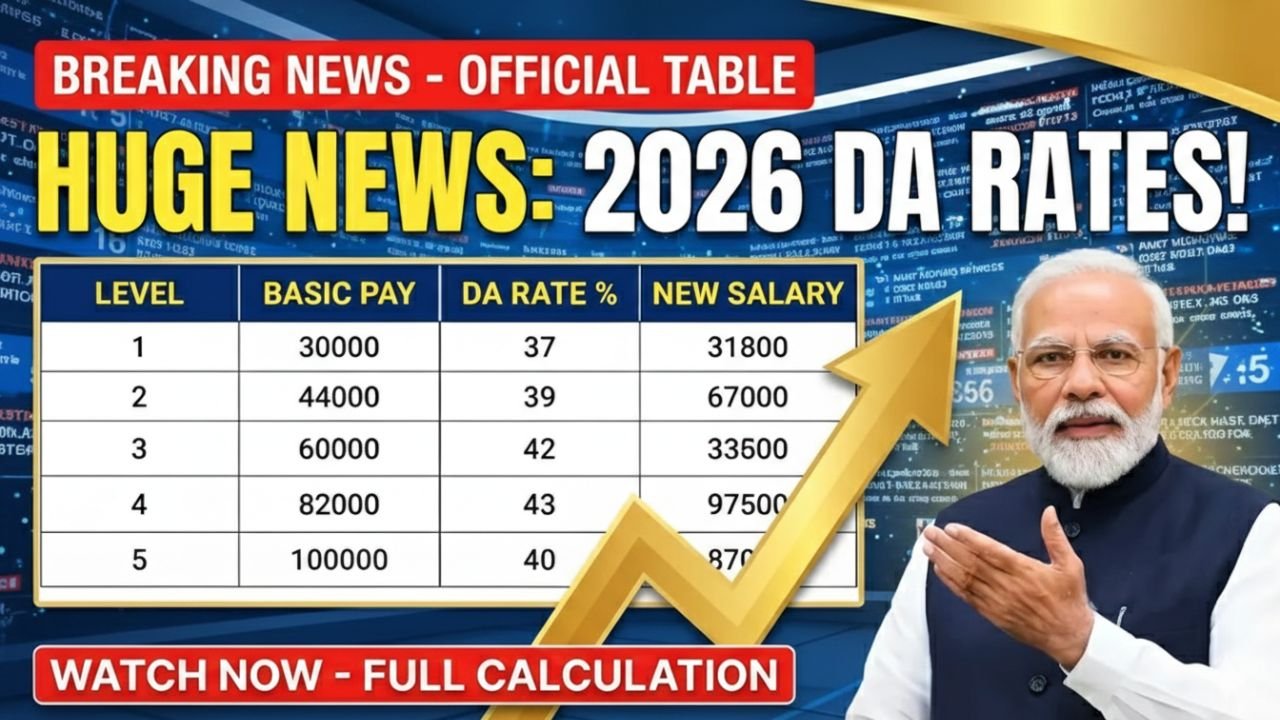
DA Hike for 2026: As we move into 2026, central government employees and pensioners across India are looking forward to the official revision of the Dearness Allowance (DA). This biannual adjustment is a vital component of financial planning for millions, serving as a buffer against the rising cost of living. This article aims to provide a clear, human-centered overview of what the DA update entails, its expected impact, and how it is calculated, all while addressing common questions through a detailed FAQ section.
What is Dearness Allowance and Why Does It Matter?
Dearness Allowance is essentially a cost-of-living adjustment paid to government employees and pensioners. Its primary purpose is to offset the impact of inflation on purchasing power. Calculated as a percentage of an individual’s basic pay, DA is revised twice a year—typically effective from January and July—though the announcements may follow later. For pensioners, this adjustment is called Dearness Relief (DR), but it functions identically. In essence, DA and DR act as essential economic stabilizers, ensuring that salaries and pensions retain their real value over time despite fluctuating market prices for essential goods and services.
A Complete Information Table 2026 DA Update Overview
| Aspect | Details |
|---|---|
| What is DA/DR? | A cost-of-living adjustment paid to central government employees (DA) and pensioners (DR). |
| Revision Frequency | Biannual (Usually effective January 1 and July 1). |
| Calculation Basis | Based on the All-India Consumer Price Index for Industrial Workers (AICPI-IW). |
| 2026 Effective Dates | Expected to be January 1, 2026, and July 1, 2026. |
| Key Impact | Directly increases monthly salary/pension; may indirectly affect linked allowances like HRA. |
| Payment of Arrears | If announcement is delayed, difference is paid retrospectively from the effective date. |
| Official Announcement | Made by the Ministry of Finance, Government of India. |
The Significance of the 2026 Revision
The upcoming 2026 DA revision holds particular importance as it unfolds within a dynamic economic landscape. Global and domestic inflationary trends, shifts in the Consumer Price Index (CPI), and overall economic recovery patterns will all influence the final percentage. For active employees, even a modest percentage increase can translate into a meaningful boost in monthly take-home pay, affecting household budgeting and savings. For retirees living on a fixed income, the corresponding DR increase is crucial for maintaining their standard of living, especially in the face of escalating healthcare and daily utility costs.
Projected Trends and Calculation Methodology
While the government will announce the official figures based on conclusive data, economic observers anticipate a continued upward trend in the DA percentage for 2026. The calculation is not arbitrary; it follows a prescribed formula based on the All-India Consumer Price Index for Industrial Workers (AICPI-IW). The government averages the AICPI-IW over a specific period to determine the exact percentage increase. This transparent, data-driven approach ensures that the adjustment directly correlates with actual inflation experienced by the workforce, making it a fair and predictable process.
Monthly Salary and Pension Impact
The implementation of the revised DA rate will be reflected in monthly salary slips and pension statements from its effective date. If there is a delay between the effective date and the official notification, employees and pensioners receive the due arrears in a lump sum, which often results in a notably higher credit for that particular month. This month-wise adjustment ensures that individuals are compensated for the increased cost of living without significant lag. Furthermore, since several other allowances like House Rent Allowance (HRA) are often linked to the basic pay, a DA hike can have a positive cascading effect on the overall compensation package.
Frequently Asked Questions (FAQs)
1. When will the 2026 DA increase be officially announced?
The announcements typically follow a few months after the effective date (January 1 or July 1). The exact timeline depends on the release of the requisite AICPI-IW data and subsequent government approval.
2. How is the DA percentage calculated?
The calculation uses a standard formula: [(Average of AICPI-IW for the past 12 months – 115.76) / 115.76] x 100. The result is rounded off to the nearest whole number to determine the final DA percentage.
3. Will the DA increase affect my gratuity and provident fund?
Dearness Allowance is a component of “basic pay” for the calculation of retirement benefits like gratuity. Therefore, an increase in DA will lead to a higher gratuity amount. However, it does not directly impact the Employee Provident Fund (EPF) contribution, which is calculated on basic pay plus DA, so the contribution amount will also see a rise.
4. Do state government employees get the same DA increase?
Not necessarily. State governments have their own policies and may announce DA revisions independently, though they often follow the central government’s trend with some variation in timing and percentage.
5. Where can I check the official update?
The official order will be published on the website of the Department of Expenditure, Ministry of Finance. Reputable news sources and dedicated government employee portals will also carry the notification.
Looking Ahead
The 2026 Dearness Allowance update is more than just a statistical adjustment; it represents a direct commitment to the financial well-being of the public service workforce and those who have served. By understanding the process and its implications, employees and pensioners can plan their finances with greater confidence and clarity. Staying informed through official channels ensures that you can accurately track the revision and its correct application to your income, providing peace of mind in an ever-changing economic environment.